CK-12 Deep Dive: The FREE Personalized Learning Powerhouse That Needs to Be in Your Toolkit

If you’re a K-12 educator, I know your struggle. We all spend endless hours on a never-ending quest for quality educational materials. We need content that’s engaging, easy to differentiate, aligned to standards, and, let’s be real, free. The idea of a magical, single platform that checks all those boxes often feels like a fantasy, right? Like finding a unicorn that also grades papers.
Well, get ready to meet your new favorite secret weapon: CK-12.org.
When we first curated our list of the best edtech tools for teachers, CK-12 was an immediate, non-negotiable inclusion. But if you’re sitting there wondering, “Wait, what even is CK-12?”—you’re not alone. Think of it as a robust, non-profit foundation that has quietly built one of the most powerful personalized learning platforms on the internet. It’s not just a website; it’s a complete solution, particularly for high-quality free high school resources in Math and Science. And, yes, it is 100% free. This isn’t just a review; it’s a deep dive into how this powerhouse can fundamentally change the way you plan and teach.
Key Features: More Than Just a Textbook
The heart of CK-12 is its expansive library of content, but you’d be making a huge mistake to think of it as just a digital textbook site. It’s so much more dynamic than that.
The Versatility of FlexBooks 2.0
Forget those heavy, expensive, and quickly outdated print textbooks. The core of CK-12’s content is delivered via their FlexBooks. What’s a FlexBook? It’s a fully customizable, interactive digital textbook.
- Adaptability is King: This is the game-changer. You don’t just use a book CK-12 made; you get to play editor! You can literally pull chapters from different CK-12 courses, rearrange the order, and even add your own notes, links to YouTube videos, and external practice resources. I once customized a FlexBook for my general science class by taking a tough chemistry concept and inserting a simpler biology review from a lower grade level right before it. It’s tailored teaching without the massive effort.
- Built-In Differentiation: The FlexBooks are structured around concepts, not just chapters. This means every topic has multiple learning modalities attached to it—videos, readings, real-world examples, and practice. If a student is struggling with the text, they can immediately pivot to a different type of resource.
Simulations and PLIX: Making Concepts Pop
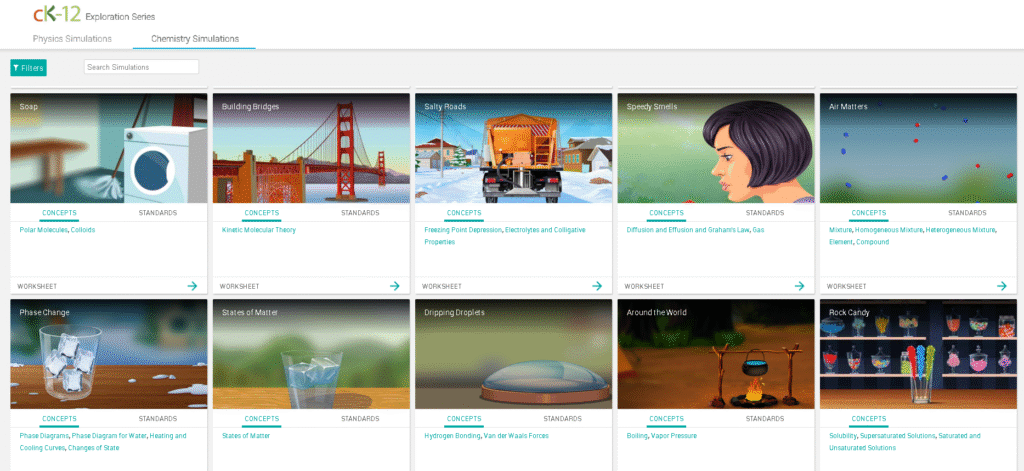
This is where CK-12 pulls ahead of most other free high school resources. They understand that just reading about concepts like inertia or stoichiometry is a snooze-fest.
- Interactive Simulations: CK-12 offers a fantastic library of interactive physics and chemistry simulations. These are clean, engaging virtual sandboxes. Students can manipulate variables—like the angle of a launch or the flow of electricity—and immediately see the resulting graphs and outcomes. It turns abstract principles into tangible, observable cause-and-effect.
- PLIX (Play, Learn, Interact, eXplore): These are little interactive nuggets embedded directly into the lessons. They are quick, fun, and challenge students to apply a concept immediately. For example, a lesson on geometry might have a PLIX where students drag points on a screen to see how the angles of a triangle change. They’re perfect for a quick “check for understanding” or as a vibrant, interactive homework assignment.
The Teacher Perspective: Seamless Implementation
Let’s be honest, a great tool that’s a nightmare to set up is still a nightmare. The good news? The setup and daily use are incredibly intuitive, making this CK-12 review overwhelmingly positive on the logistics side.
Assignment Creation and Progress Tracking
The platform makes it simple to assign specific concepts—a FlexBook section, a simulation, and an Adaptive Practice quiz—all in one neat package.
The analytics are simple and actionable—a huge win. You can see a class-level “heatmap” of where your students are struggling (e.g., “It looks like 75% of my students missed question 4 on the Adaptive Practice for ‘Vectors’.”). This insight allows you to immediately adjust your next day’s mini-lesson, focusing only on the specific learning gap, rather than reteaching the whole chapter. It’s targeted intervention that saves you time!
Integration with Google Classroom
If you live in the Google ecosystem, CK-12 is your friend. It works seamlessly with Google Classroom. You don’t have to create separate classes on the CK-12 site. You simply assign content from CK-12 directly to your existing Google Classroom, and the scores pass right back to your gradebook. This eliminates the headache of managing multiple platforms and is one of the features I appreciate most about this edtech tool for teachers. It just… works. No double entry!
The Student Perspective: Learning, Personalized
The true test of any personalized learning platform isn’t what the dashboard looks like for the teacher; it’s what the experience is like for the kid in the back row. This is where CK-12 really shines.
The Adaptive Practice Magic
CK-12 doesn’t just give students a static ten-question quiz. Their Adaptive Practice feature is built on machine learning and genuinely promotes personalized learning.
- Targeted Help: If a student is struggling with a concept, the practice engine doesn’t just mark them wrong and move on. It switches the question difficulty, offers a hint, or even provides content from a prerequisite concept to fill the knowledge gap. It’s like having a dedicated digital tutor sitting right next to them, constantly adjusting to their needs.
- Flexi, the AI Tutor: Students can chat directly with Flexi, the platform’s AI tutor. They can ask clarifying questions about a concept, get step-by-step solutions to practice problems, or even ask Flexi to outline a FlexBook section. It gives students 24/7 support and encourages that crucial self-directed learning we’re all trying to foster.
A Choice in Modality
Students aren’t just clicking through text. They have a variety of ways to engage, which is key for different learning styles:
- The Reader: Sticks to the FlexBook reading.
- The Visual Learner: Watches the embedded video and plays with the PLIX.
- The Experimenter: Dives into the simulations.
- The Self-Pacer: Uses the Adaptive Practice to move quickly through known material and slow down on challenging concepts.
The clean interface and variety of options mean students are more likely to take ownership of their learning. It moves the conversation from, “Why did I get a C?” to “I know I need to spend more time with the simulation on that topic.” As a teacher, that shift in dialogue is priceless
Conclusion/Call to Action
In an era where districts are constantly tightening their budgets and the pressure to find meaningful, high-quality free high school resources is intense, CK-12 is a standout solution. It’s an authentic personalized learning platform that is rich in content, seamlessly integrates with common LMS tools like Google Classroom, and is genuinely designed with the needs of both the modern teacher and the modern student in mind.
If you’ve been hesitant to fully embrace an edtech tool for teachers or are simply tired of hunting down supplemental materials, I urge you to stop browsing and start building. Go take a tour, customize your first FlexBook, and send an Adaptive Practice assignment to your class today.
Don’t wait. Go add this revolutionary, zero-cost CK-12 powerhouse to your toolkit right now and see the difference a truly flexible resource makes!